Dreams and nightmares are vivid mental experiences that happen during sleep. A dream may feel peaceful, strange, emotional, or realistic, while a nightmare is a disturbing dream that can trigger fear, anxiety, or distress and sometimes wake you suddenly.
Both can occur during different sleep stages, although the most vivid dreams often happen during REM sleep. Dreams may be influenced by memories, emotions, stress, daily experiences, sleep patterns, medications, or difficult life events.
Scientists have not found one universal explanation for why people dream, and there is no scientifically proven meaning for every dream symbol. A falling dream, for example, can mean something different to different people.
Understanding dreams is often more useful when you consider the emotions, circumstances, and experiences surrounding them. Recurring nightmares may also deserve attention, especially when they interfere with sleep, mood, or daily life.
Key Takeaways
- Dreams can occur during several stages of sleep, with vivid dreaming common during REM sleep.
- Nightmares are disturbing dreams that often involve threats, fear, or intense negative emotions.
- Stress, anxiety, trauma, irregular sleep, some medications, alcohol or substance changes, and certain sleep conditions can contribute to nightmares.
- A dream symbol does not have one proven meaning for everyone.
- Personal experiences and emotions are often more useful when exploring what a dream may mean.
- Recurring nightmares that disrupt sleep or daytime life may require professional support.
- Imagery rehearsal therapy is one evidence-based treatment used for persistent nightmares, including nightmares associated with PTSD.
What Are Dreams and Nightmares?
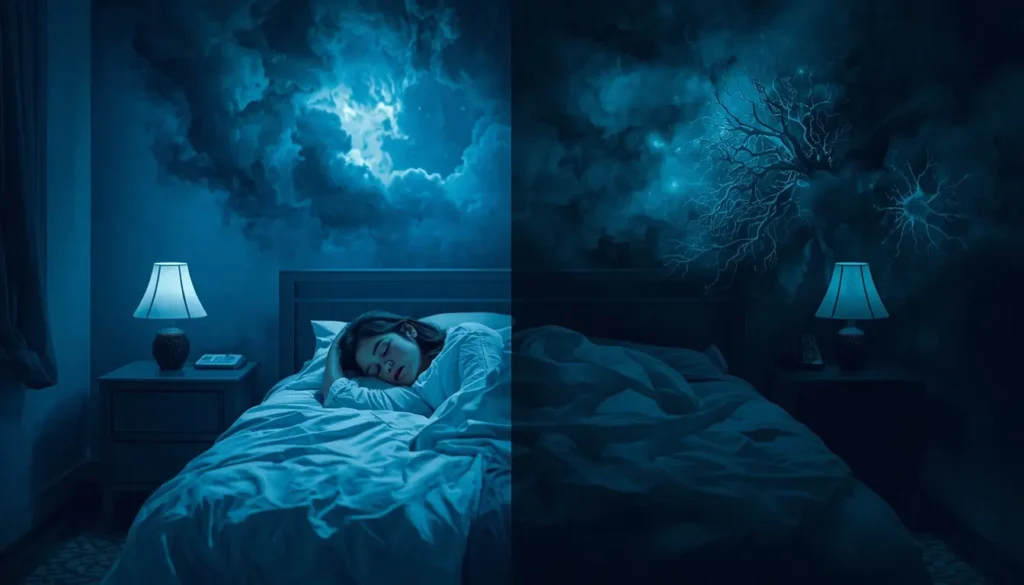
Dreams are mental images, thoughts, sensations, and stories that occur while you sleep. They may be realistic, strange, emotional, fragmented, or completely disconnected from your waking life.
You may dream about ordinary activities, familiar people, places you have never visited, or situations that could never happen in real life. Sometimes a dream feels like a complete story. Other times, it seems to jump from one scene to another without a clear connection.
Nightmares are different because they usually involve distressing emotions. A nightmare may make you feel frightened, helpless, angry, embarrassed, sad, or threatened. It often wakes you, and you may remember the dream clearly afterward.
Dreams vs. Nightmares
| Feature | Dreams | Nightmares |
| Emotional tone | Can be positive, neutral, strange, or negative | Usually distressing or frightening |
| Awakening | May or may not wake you | Often causes awakening |
| Memory | May be forgotten quickly | Often remembered after waking |
| Themes | Almost anything | Often involve threats, danger, loss, or helplessness |
| Effect | May have little daytime impact | Can affect mood, sleep, and daytime functioning |
| Meaning | Personal and subjective | Personal and subjective |
An important distinction is that not every unpleasant dream is a nightmare disorder. Occasional nightmares are common. Nightmare disorder is considered when disturbing dreams occur often enough to cause significant distress, sleep disruption, or problems during the day.
Why Do We Dream?
Scientists have studied dreaming for decades, but there is no single answer that explains every dream.
One reason is that dreams are difficult to study directly. Researchers can monitor brain activity and wake people during sleep, but they cannot simply observe a person’s subjective dream experience as if it were a movie playing on a screen.
Memory and Emotional Processing
One major area of research connects dreaming with memory and emotional processing. REM sleep involves significant brain activity, and researchers continue to investigate how sleep supports memory and other cognitive functions.
For example, imagine that you spend all day preparing for an important presentation. That experience may appear in your dream in an unusual form. You might dream that you are standing on a stage, unable to find your notes, even though you were perfectly prepared in real life.
The dream does not necessarily predict failure. It may simply reflect how strongly the experience affected you.
Why Dreams Can Feel So Strange
Dreams often combine memories, emotions, people, places, and ideas in unusual ways. During REM sleep, brain activity differs from waking consciousness, which may contribute to the surreal quality of many dreams.
This can explain why you might dream about your childhood home while talking to a person you have not seen in years, even though neither has been on your mind recently.
Dreams do not always follow the logical rules of waking life.
Why Do We Have Nightmares?
Nightmares can have many possible triggers. There is no single cause that applies to everyone.
Stress and Anxiety
Daily stress is one common factor associated with nightmares. Work pressure, relationship problems, financial concerns, moving to a new home, major life changes, or grief can influence sleep and dream content.
For example, someone worried about losing a job might repeatedly dream about arriving late, being unprepared, or failing an important task.
That does not mean the dream predicts unemployment. It may reflect the emotional pressure already present during waking hours.
Trauma and PTSD
Nightmares can also occur after traumatic experiences. People with post-traumatic stress disorder (PTSD) may experience frightening dreams or sleep problems related to traumatic memories.
However, having a nightmare does not mean someone has PTSD. Nightmares can occur in people without a trauma-related disorder.
Sleep Loss and Irregular Sleep
Changes in your normal sleep schedule can increase the likelihood of nightmares. Sleep deprivation, insomnia, and disrupted sleep have been associated with more frequent nightmares.
A simple example is staying awake much later than usual for several nights and then sleeping at unusual times. Your sleep may become fragmented, making dreams more noticeable or easier to remember.
Medications and Substances
Some medications can contribute to nightmares in certain people. Mayo Clinic notes that certain antidepressants, blood pressure medications, beta blockers, Parkinson’s medications, and smoking-cessation drugs may be associated with nightmares.
Alcohol use, recreational drugs, or withdrawal from some substances can also affect dreaming.
If nightmares begin after starting, stopping, or changing a medication, talk with your healthcare professional rather than changing the medication yourself.
Frightening Movies and Stories
For some people, scary movies, books, games, or other frightening material close to bedtime may influence dream content.
This is especially easy to understand when you watch a horror movie and then dream about its setting later that night.
The dream is not necessarily meaningful in a deeper sense. Sometimes the brain simply carries recent material into sleep.
What Do Common Dreams Mean?
People have searched for dream meanings for centuries. Modern psychology, cultural traditions, spirituality, and popular dream dictionaries all offer different interpretations.
The key point is that dream interpretation is subjective.
There is no reliable scientific rule saying that dreaming about water, teeth, snakes, falling, or flying must have one specific meaning.
Cleveland Clinic notes that there is no consistent, scientifically proven system linking particular dream content to one universal meaning.
Instead of asking, “What does this symbol always mean?” a better question is:
“What does this image mean to me, based on my current life and emotions?”
Common Dream Themes
| Dream Theme | Possible Personal Connection |
| Falling | Feeling uncertain, overwhelmed, or out of control. |
| Being chased | Avoiding a stressful situation or difficult emotion. |
| Being unprepared | Pressure, self-doubt, or fear of failure. |
| Flying | Freedom, excitement, confidence, or a desire for escape. |
| Losing something | Anxiety about change, separation, or uncertainty. |
| Being trapped | Feeling limited or unable to make a choice. |
| Water | May reflect emotions, memories, or personal associations. |
| Meeting someone from the past | Memories, unresolved feelings, or recent reminders. |
These are possible associations, not scientific diagnoses.
For example, falling might represent uncertainty for one person. For another, it may simply be related to a recent experience, a movie, a physical sensation during sleep, or a random dream sequence.
How Emotions Can Be More Important Than Symbols
Suppose you dream about a locked door.
The door itself may not be the most important detail. Ask how you felt.
Did you feel:
- Afraid?
- Curious?
- Frustrated?
- Safe?
- Excited?
- Relieved when the door opened?
The emotional response may provide more useful personal information than a standard dream dictionary definition.
The Psychology of Dreams and Nightmares
Several psychological traditions have attempted to explain dreams.
Sigmund Freud viewed dreams as connected to unconscious wishes and repressed material. Carl Jung developed a different approach involving archetypes and the collective unconscious.
These theories remain influential in the history of psychology, but their specific claims about dream interpretation have not been established as universal scientific facts.
Modern sleep research takes a broader approach.
Researchers examine relationships between dreaming, memory, emotion, brain activity, stress, sleep stages, and mental health. The goal is less about finding a universal dream dictionary and more about understanding how dreaming fits into human sleep and cognition.
A Practical Modern Approach
When interpreting a dream, consider three layers:
What happened?
Write down the people, places, objects, and events.
How did you feel?
Identify the strongest emotions during the dream and after waking.
What is happening in your life?
Think about current stress, relationships, decisions, memories, fears, hopes, and recent experiences.
This approach avoids treating dreams as guaranteed predictions.
Spiritual and Cultural Interpretations of Dreams
Dreams have spiritual importance in many cultures and religious traditions. Some people see dreams as opportunities for reflection, warnings, messages, or spiritual experiences.
Those beliefs can be meaningful to the person who holds them. However, spiritual interpretation should be separated from scientific evidence.
Science can study sleep, brain activity, memory, emotions, and nightmare patterns. It cannot establish that a particular dream came from a supernatural source or that a specific symbol predicts a future event.
A Balanced Way to Explore Spiritual Meaning
If spirituality is important to you, you can reflect on a dream without treating your interpretation as absolute.
For example, after a powerful dream, you might ask:
- Does this experience encourage self-reflection?
- Does it remind me of a value I want to live by?
- Bring attention to an emotion I have ignored?
- Does it connect with my personal faith or cultural tradition?
- Can I find a constructive lesson without assuming the dream predicts the future?
This approach respects spiritual beliefs while keeping the difference between personal faith, cultural symbolism, and scientific evidence clear.
How to Stop or Reduce Nightmares
An occasional nightmare usually does not require treatment. But if nightmares happen frequently, disturb your sleep, or affect your daytime life, it is worth addressing the underlying factors.
Build a Consistent Sleep Routine
Try going to bed and waking up at roughly the same times each day.
A calm pre-bed routine may also help. Reading, gentle relaxation, breathing exercises, or another quiet activity can make the transition to sleep easier. Mayo Clinic recommends maintaining a regular and relaxing bedtime routine for people dealing with nightmares.
Identify Possible Triggers
Keep a simple sleep and dream journal for a couple of weeks.
Record:
- Bedtime and wake time
- Major stressors
- Sleep quality
- Nightmares
- Alcohol or other substances
- Medication changes
- Late-night entertainment
- Major emotional events
Patterns may become easier to see.
Try Imagery Rehearsal Therapy
Imagery rehearsal therapy is an evidence-based approach used for recurring nightmares.
The basic idea is to rewrite the nightmare while awake, creating a less threatening ending or storyline, and then rehearse the revised version mentally. Mayo Clinic identifies imagery rehearsal therapy as a treatment that may reduce nightmare frequency, particularly for nightmares associated with PTSD.
A therapist can guide this process, especially when nightmares are severe or connected to trauma.
Address the Underlying Problem
Sometimes the most effective way to reduce nightmares is to address what is affecting sleep in the first place.
That might mean treating anxiety, managing stress, addressing insomnia, reviewing medications with a doctor, or evaluating another sleep problem.
Do not assume that every recurring nightmare is purely psychological.
When Dreams and Nightmares May Need Professional Attention
Most dreams do not require medical attention. Occasional nightmares are also usually not a reason for concern.
You should consider talking with a healthcare professional if nightmares:
- Happen frequently and persist over time.
- Regularly wake you.
- Make you afraid to go to sleep.
- Cause significant daytime sleepiness.
- Interfere with work, school, or relationships.
- Cause ongoing distress or anxiety.
- Begin after a medication change.
- Occur alongside other major sleep problems.
Mayo Clinic notes that nightmare disorder is diagnosed based on the pattern and impact of the nightmares, rather than through one routine test. In some cases, a sleep study may be recommended to look for another sleep disorder.
What About Acting Out Dreams?
There is an important difference between having a vivid nightmare and physically acting out a dream.
REM sleep behavior disorder can involve talking, shouting, kicking, punching, or other movements that appear connected to dream content. This is different from an ordinary nightmare and deserves medical evaluation.
If you or a bed partner notice repeated, potentially dangerous movements during sleep, speak with a healthcare professional or sleep specialist.
Dreams and Nightmares: What Should You Take From Them?
Dreams can be fascinating because they sit at the intersection of sleep, memory, emotion, imagination, and personal experience.
A pleasant dream may leave you feeling hopeful. A strange dream may simply make you curious. A nightmare may reflect stress, disrupted sleep, recent experiences, or other factors. Sometimes, however, a dream may not have an obvious explanation at all.
The most useful approach is to stay curious without becoming overly certain.
Instead of believing that every dream predicts something, look for patterns. Notice your emotions. Consider what has been happening in your waking life. If a nightmare keeps returning, focus not only on the dream itself but also on your sleep quality, stress level, health, medications, and recent experiences.
Dream interpretation can be a tool for reflection. It should not replace professional evaluation when sleep problems become persistent or severe.
A Simple Dream Reflection Exercise
After waking, write down three things:
The dream: What happened?
The emotion: What did you feel most strongly?
The connection: What in your current life feels similar?
This takes only a few minutes and can help you understand recurring themes without forcing a fixed interpretation.
Conclusion
Dreams and nightmares are a normal but still partly mysterious part of human sleep. Dreams can include memories, emotions, familiar people, strange settings, and completely unexpected stories.
Nightmares are more distressing and may be influenced by stress, anxiety, trauma, disrupted sleep, medications, substances, or other factors.
No scientifically proven dream dictionary can tell you exactly what every symbol means. A dream about falling does not automatically mean one thing, and dreaming about a person does not necessarily reveal a hidden message.
Personal context matters.
If you enjoy spiritual or cultural dream interpretation, it can be a meaningful form of reflection as long as it is treated as subjective rather than proven fact. For recurring nightmares, focus on the quality of your sleep and possible underlying causes.
Evidence-based approaches such as imagery rehearsal therapy can help people whose nightmares become persistent or disruptive.
Ultimately, dreams can offer interesting clues about your inner experience, but they should be explored with curiosity, not fear.
FAQs:
What is the difference between dreams and nightmares?
Dreams are mental experiences that occur during sleep and can be positive, neutral, strange, or negative. Nightmares are disturbing dreams that usually create strong negative emotions and may wake you.
Why do I keep having the same nightmare?
Recurring nightmares may be associated with stress, anxiety, trauma, disrupted sleep, or other factors. The meaning is not universal, so consider what emotions and life experiences are connected to the recurring dream. If the nightmares repeatedly disrupt your sleep or daytime functioning, talk with a healthcare professional.
Do nightmares have a deeper meaning?
They can have personal meaning, but there is no scientifically proven system in which specific dream symbols always have the same meaning. Your emotions, memories, current circumstances, and personal associations may provide more useful context.
Can stress cause dreams and nightmares?
Yes. Stress and anxiety are associated with more frequent or distressing dreams and can contribute to nightmares. Major life changes, relationship problems, work pressure, grief, and other stressful experiences may affect dream activity.
When should I worry about nightmares?
Occasional nightmares are usually not a concern. Consider professional help when nightmares happen frequently, repeatedly disturb your sleep, cause fear of bedtime, create daytime problems, or produce significant distress.
Read More Posts:
- Dreams & Nightmares Case: Story and Investigation Details
- Dreams Los Cabos: Complete Guide for Your Vacation In 2026
- Vivid Dreams Meaning: Why Your Dreams Feel So Real

Daniel Brooks is a passionate writer at WorldofDreamsz.Com specializing in dream meanings and spiritual interpretations. He aims to provide easy-to-understand insights that help readers find meaning and purpose in everyday life.