What happens to a dream when you have to wait for it or watch it move out of reach? This question lies at the heart of Harlem, a famous poem by Langston Hughes.
The phrase “what happens to a dream deferred” refers to the effects of delaying or denying a person’s hopes, goals, or desire for a better life.
Published in 1951, the poem uses vivid images to show how an unfulfilled dream may lose its energy, cause emotional pain, become a heavy burden, or trigger anger and social unrest.
Beyond personal ambition, Hughes explores racial injustice, unequal opportunities, and the frustration that grows when society promises progress but fails to deliver it.
Through powerful comparisons, rhetorical questions, and a dramatic ending, he encourages readers to consider the consequences of ignored aspirations.
Understanding the poem’s historical context and symbolism helps explain its lasting message about hope, disappointment, equality, and the human need for a better future.
Key Takeaways
- Meaning: A dream deferred is a hope, goal, or aspiration that has been postponed or denied.
- Author: Langston Hughes, an influential African American poet associated with the Harlem Renaissance.
- Poem: Harlem, published in 1951 as part of Montage of a Dream Deferred.
- Main themes: Frustration, lost opportunities, racial inequality, hope, and resistance.
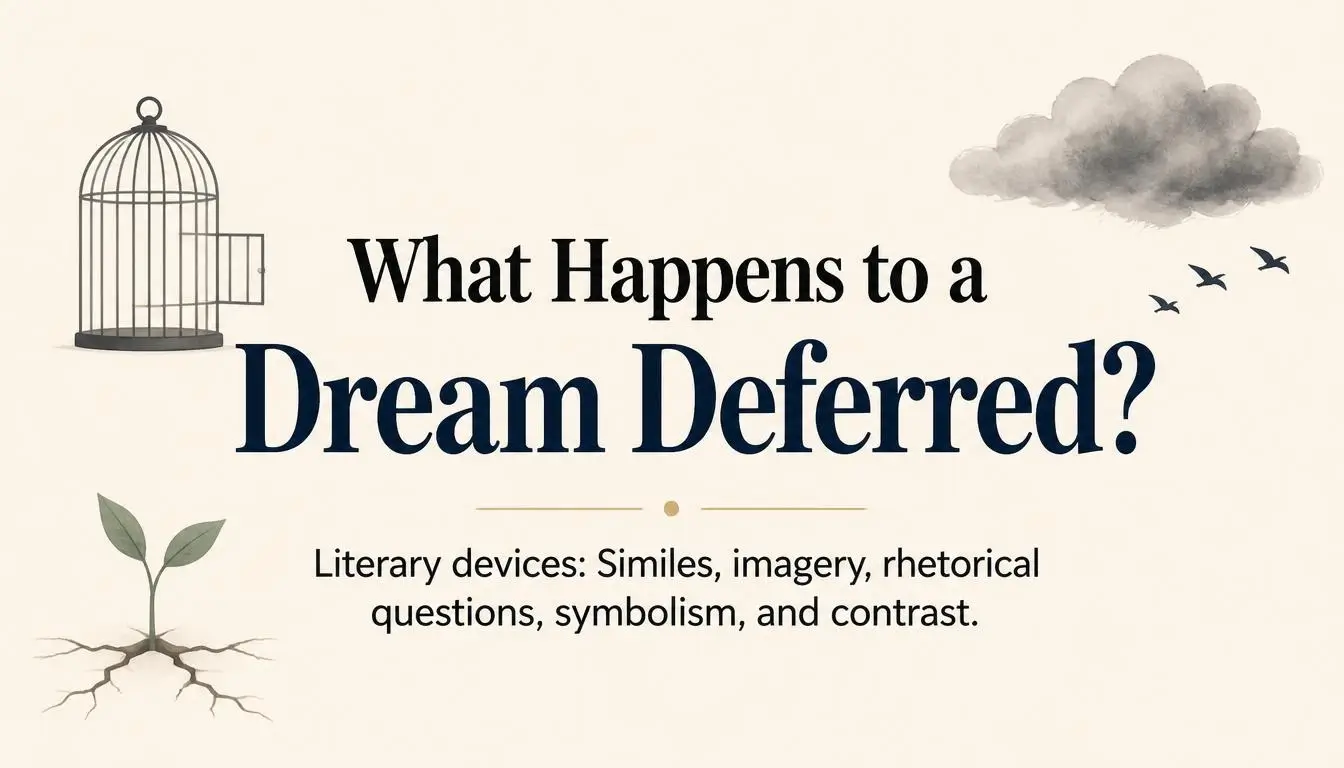
- Literary devices: Similes, imagery, rhetorical questions, symbolism, and contrast.
- Central message: Ignoring people’s dreams and needs can cause lasting emotional and social harm.
1. What Does “What Happens to a Dream Deferred” Mean?
The phrase asks what happens when someone cannot pursue an important dream at the right time. The dream might involve education, a career, financial security, equal treatment, or a better future for the next generation. When circumstances repeatedly block that goal, the person may begin to feel disappointed, powerless, or angry.
The word deferred means postponed or delayed. It does not necessarily mean that a dream has disappeared forever. Instead, it suggests that the dream remains unfulfilled while time passes and circumstances change.
For example, imagine a student who works hard to attend college but cannot afford tuition. The student may continue hoping for an education, but each year of delay can make that goal feel more distant. Financial pressure, family duties, and lost opportunities may slowly change how the student feels about the future.
Hughes uses this idea to raise a larger question: what happens when people must keep waiting for opportunities that others can access more easily?
What is a dream deferred in simple words?
A dream deferred is a goal or hope that has been put off or denied. It can be a personal ambition, such as getting a degree, or a shared hope, such as achieving equal rights. The phrase highlights the emotional cost of waiting when there is no clear path toward success.
Is a deferred dream the same as a failed dream?
Not exactly. A failed dream is one that has not succeeded, while a deferred dream has been delayed or prevented from becoming real.
A deferred dream may still come true. However, repeated delays can change the dream itself. A person may lose motivation, develop new goals, or become frustrated by barriers that seem impossible to overcome.
Hughes leaves the outcome open. His poem does not offer one fixed answer because different people and communities respond to disappointment in different ways.
2. Who Wrote the Poem, and What Is Its Historical Context?
Langston Hughes: Biography, Poet, Harlem Renaissance Writer
Langston Hughes (1901–1967)
Poet, novelist, playwright, and social commentator
Hughes became a major voice of the Harlem Renaissance, a cultural movement associated with Black artistic expression and intellectual life during the 1920s and beyond. His writing explored everyday experiences, racial injustice, identity, music, and the search for dignity in American life.
His poem Harlem appeared in 1951 as part of Montage of a Dream Deferred, a larger collection exploring Black life in Harlem, New York. The Poetry Foundation explains that the poem’s question connects individual aspirations with the broader promise of equality in America.
The connection to racial inequality
During Hughes’s lifetime, Black Americans faced widespread racial discrimination, segregation, and unequal access to housing, education, employment, and political power. These barriers made many ordinary hopes harder to achieve.
In this context, the dream in Harlem can represent the desire for a society in which Black Americans could enjoy the freedom, safety, opportunity, and dignity that the country claimed to value.
The poem does not name one specific dream. That choice allows its meaning to include several connected aspirations, from individual success to collective equality.
The connection to the American Dream
The American Dream is the belief that people should have opportunities to improve their lives through effort and determination. Hughes questions what happens when that promise remains out of reach for certain groups.
If people are told that hard work leads to success but face barriers they cannot overcome through effort alone, hope may become frustration. The poem asks readers to consider the cost of that contradiction.
Its historical meaning is especially important. Although modern readers can apply the poem to many kinds of disappointment, its connection to racial injustice should not be overlooked.
3. What Do the Images in Harlem Symbolize?
One reason Harlem remains powerful is that Hughes does not explain the effects of a delayed dream in abstract terms. Instead, he compares it to familiar objects and physical experiences. These images make disappointment feel real, almost as if readers can see, smell, and feel what happens.
The poem moves through several possibilities, beginning with decay and discomfort before ending with a heavier burden and the threat of an explosion.
The following table explains the main images without reproducing the poem in full.
| Image in the poem | Possible symbolic meaning |
| A dried piece of fruit | A dream that loses its freshness or vitality. |
| An infected wound | Emotional pain that grows when ignored. |
| Spoiled meat | Disappointment that becomes difficult to bear. |
| Hardened sweetness | A dream that changes into something less satisfying. |
| A heavy load | The ongoing burden of unfulfilled hopes. |
| An explosion | Anger, rebellion, or a dramatic breaking point. |
These interpretations are not separate answers that Hughes confirms one by one. They are possibilities created by the poem’s questions and imagery.
They suggest that postponing a dream can have several effects rather than one predictable outcome.
A dream that dries up
The dried-fruit image suggests that something once fresh can lose its vitality over time. A dream may begin with excitement, confidence, and a clear sense of purpose. If it remains out of reach, the person who holds it may gradually lose that excitement.
Consider someone who wants to become a doctor but faces years of financial hardship. The goal may remain important, yet the person could begin to question whether pursuing it is realistic.
This image suggests that delay can weaken hope without immediately destroying it.
A dream that becomes painful
The image of an infected wound suggests that ignored pain may worsen rather than disappear. In the context of a deferred dream, it represents disappointment that remains unresolved.
For instance, a worker who repeatedly experiences unfair treatment may try to ignore the problem to keep a job. Over time, resentment may grow, especially if no one listens or offers a fair solution.
The image encourages readers to think about what happens when suffering is left unaddressed. Time alone does not always heal a problem when the conditions causing it remain unchanged.
A dream that becomes unpleasant or loses its appeal
The images of spoiled food and hardened sweetness explore two different outcomes. One suggests that disappointment can become deeply unpleasant. The other suggests that something once attractive may change when it is left unattended.
A person might spend years working toward a promotion, only to discover that the opportunity has disappeared or that their priorities have changed. Even if the original goal remains possible, it may no longer offer the same satisfaction.
These images show that postponement can affect both a person’s feelings and the dream itself.
A dream that becomes a burden
The image of a heavy load shifts the focus from decay to weight. A deferred dream may remain alive, but carrying it without progress can become exhausting.
A parent who wants to provide a better future for their children may feel this pressure while working long hours and struggling with rising expenses. The dream continues to motivate the parent, but it also adds emotional weight.
This image is especially effective because burdens do not always produce an immediate reaction. People can carry disappointment for years before others recognize how much it costs them.
4. Why Does the Poem End With the Idea of an Explosion?
The final image changes the tone of the poem. Earlier images suggest gradual decay, discomfort, or exhaustion. The ending introduces a sudden and potentially dangerous response.
An explosion can symbolize the point at which accumulated frustration becomes impossible to contain. When people repeatedly experience injustice, ignored concerns, or blocked opportunities, their anger may eventually become visible through protest, resistance, or conflict.
The personal meaning of an explosion
On an individual level, the image may represent an emotional breaking point. Someone who has spent years hiding disappointment might finally speak openly, leave an unfair situation, or decide to change direction.
For example, an employee who repeatedly receives promises of promotion without any real progress may eventually stop accepting those promises. The resulting decision could be difficult, but it may also mark the beginning of a more honest response to the problem.
The important distinction is that emotional pressure does not always lead to violence. It may lead to conversation, organized action, boundary-setting, or a search for new opportunities.
The social and political meaning
In the historical context of Harlem, the explosive ending can suggest the danger of continued racial oppression. When a society repeatedly denies people fair opportunities, the consequences can extend beyond individual disappointment.
The ending is therefore not merely about losing patience. It asks what society risks when it ignores the needs and aspirations of an entire community.
The Poetry Foundation’s analysis discusses the final image in relation to unrest, social change, population growth, and the challenge to false assumptions about American equality.
Does the explosion have only a negative meaning?
No. The image is unsettling, but an explosion can also suggest a sudden release of pressure or a dramatic break with existing conditions.
In a broader interpretation, it might represent a movement that forces people to confront a problem they have ignored. That does not make every form of explosive action positive or justified. Rather, it highlights the possibility that suppressed demands eventually require a response.
Hughes ends with uncertainty, leaving readers to consider the consequences instead of providing a simple solution.
5. What Literary Devices Make the Poem So Powerful?
Hughes uses a small number of literary devices to create a strong emotional effect. The poem’s language is direct, but its images and structure invite readers to think beyond the literal meaning of each comparison.
Similes and sensory imagery
A simile compares one thing with another, often using words such as like or as. Hughes relies on similes to connect an abstract idea—a delayed dream—to ordinary physical experiences.
Instead of simply saying that disappointment hurts, he creates images associated with drying, infection, decay, sweetness, and weight. These comparisons make an invisible emotional process easier to understand.
The sensory details also affect the mood. Some images are unpleasant, encouraging discomfort, while others suggest exhaustion. The final image then introduces a much more dramatic possibility.
Rhetorical questions
A rhetorical question encourages thought rather than requesting a straightforward answer. Hughes builds the poem around a series of questions about the possible fate of an unfulfilled dream.
This structure matters because the speaker never claims that every dream follows the same path. Each question introduces another possibility, making the reader consider the different costs of delay.
The questions also place responsibility on the audience. Readers must decide whether they have noticed the harm caused by blocked opportunities and what they believe should happen next.
Symbolism
A symbol is an object, image, or action that represents a larger idea. In Harlem, the dream represents hopes and aspirations, while the physical comparisons suggest the emotional and social effects of preventing those hopes from becoming real.
The dream is not limited to one person’s ambition. It can stand for the collective hope of a community seeking fair treatment and meaningful opportunity.
Contrast and structure
The poem contrasts gradual deterioration with sudden action. Its earlier images develop a sense of decline, while the final question creates uncertainty and tension.
That shift gives the ending much of its force. Readers have considered several quiet forms of suffering before being confronted with the possibility of a dramatic response.
Sound and rhythm
Hughes’s short lines, repeated question patterns, and strong end sounds help create a memorable rhythm. The language can be read aloud with a conversational quality, yet the movement between images gives it urgency.
The poem’s connection to jazz and other forms of Black musical expression also fits Hughes’s wider interest in the sounds and rhythms of everyday Black life. His collection Montage of a Dream Deferred uses varied rhythms and shifts in voice to portray Harlem as a changing community.
6. What Are the Main Themes of Harlem?
Although the poem is brief, its meaning reaches across several connected themes. Understanding these themes helps explain why the question about a deferred dream applies to both personal life and society.
Hope and disappointment
Hope encourages people to work toward a better future. However, when a goal remains out of reach, hope can become mixed with frustration.
Hughes explores this tension without suggesting that hope always disappears. A dream may remain alive even when the person holding it becomes tired or uncertain.
Racial injustice and unequal opportunity
The poem’s historical setting gives its social message particular importance. It challenges the idea that everyone has an equal chance to achieve their goals when racial barriers prevent some people from accessing the same opportunities as others.
This theme remains relevant to discussions of discrimination, educational access, housing, employment, and equal rights. Modern examples should be examined on their own evidence, but the poem offers a useful framework for thinking about the human costs of exclusion.
Emotional suppression
The poem also asks what happens when disappointment has no healthy or effective outlet. A person may hide anger to avoid conflict, protect a relationship, or keep a job.
However, hiding an emotion does not necessarily resolve the situation that caused it. The poem invites readers to consider the difference between managing difficult feelings and ignoring the underlying problem.
Personal freedom and social responsibility
A dream often depends on more than individual determination. A student needs access to education, a worker needs fair opportunities, and a community needs institutions that treat people justly.
Hughes’s message challenges explanations that blame people for every unfulfilled goal. Sometimes the barriers are personal, but sometimes they are rooted in larger social conditions.
The need to listen
The poem’s unanswered questions encourage readers to pay attention to the experiences of others. Rather than telling the audience exactly what to think, Hughes makes them consider what may happen when important hopes are repeatedly denied.
Listening, acknowledging unfair conditions, and responding before frustration deepens are practical ways to engage with the poem’s central concern.
7. How Does the Meaning Apply to Everyday Life?
The phrase a dream deferred has become useful because it describes experiences that can occur in many parts of life. While Hughes’s original historical context remains essential, readers can also connect the poem’s central question to personal goals and present-day challenges.
The following examples show how its message can be applied without assuming that every delayed dream will end in disappointment or conflict.
Education and career goals
A person may want to attend college, start a business, or enter a chosen profession but face financial, family, or practical barriers. The delay can create doubt, particularly when other people appear to move forward more quickly.
The poem encourages readers to recognize the emotional cost of these barriers. It also raises a useful question: what support would make the goal more achievable?
Relationships and family expectations
Someone may hope to repair a relationship, start a family, or reconnect with a loved one. Circumstances may prevent that hope from becoming real.
In such situations, the meaning of a deferred dream may involve grief, changing expectations, or the difficult decision to pursue a different future. The poem does not suggest that every dream must be preserved forever. It encourages readers to consider what happens when important hopes remain unresolved.
Social change and equal rights
Communities may seek fair laws, better public services, safer neighborhoods, or equal access to opportunity. When progress is repeatedly delayed, trust in institutions may weaken.
Hughes’s poem reminds readers that social promises have consequences. A society cannot assume that people will wait indefinitely without emotional, political, or cultural effects.
How can someone respond to a deferred dream?
The poem is mainly a work of literary and social criticism, not a step-by-step self-help guide. Still, its ideas can support a thoughtful response to personal disappointment.
- Name the barrier: Identify whether the delay comes from money, time, discrimination, health, or another challenge.
- Review the goal: Decide whether the dream still reflects your needs and values.
- Seek support: Consider advice, education, financial planning, or help from trusted people.
- Make a realistic plan: Break a large goal into smaller steps when possible.
- Address unfair treatment: If the barrier involves discrimination or an unjust system, consider appropriate ways to seek support or advocate for change.
These steps cannot solve every problem, especially when barriers are structural or outside an individual’s control. However, they can help distinguish a temporary delay from a situation that requires a different approach.
The larger lesson is not that every dream must succeed. It is that unfulfilled hopes deserve attention, and the conditions preventing progress should not be ignored.
8. Why Is Harlem Still Relevant Today?
The poem remains relevant because people continue to face the gap between what they are promised and what they can actually achieve. Its question applies wherever personal ambition meets financial pressure, social exclusion, or repeated disappointment.
Its influence can also be seen in literature and public discussion. The title of Lorraine Hansberry’s play A Raisin in the Sun, which debuted on Broadway in 1959, draws from an image in Hughes’s poem. The connection helped bring the poem’s ideas to a wider audience.
The poem’s influence on American literature
Hughes helped establish a powerful way of writing about Black American experiences through accessible language, music, everyday life, and social observation. His work showed that a short poem could address large questions about dignity, opportunity, and justice.
The influence of Harlem extends beyond the classroom because its central question remains open. Readers can approach it from different generations and circumstances while still recognizing its historical foundation.
What modern readers can learn
The poem encourages people to look beyond individual outcomes and examine the conditions that shape them. When someone fails to reach a goal, it is worth asking whether the problem involves effort, access, timing, or an unfair obstacle.
It also warns against assuming that patience alone will solve every difficulty. Sometimes a delayed goal requires a new plan. At other times, the barrier must be addressed directly.
Above all, Harlem asks readers to take human hopes seriously. Dreams are not simply private wishes. They can reflect a person’s sense of identity, belonging, freedom, and future.
Conclusion:
The meaning of “what happens to a dream deferred” centers on the emotional and social consequences of postponing or denying important hopes.
In Harlem, Langston Hughes explores several possible outcomes, including fading hope, growing pain, exhaustion, and a dramatic release of frustration. His vivid images turn an abstract question into an experience readers can understand and remember.
The poem also carries a powerful historical message. Published in 1951, it reflects the struggles of Black Americans facing racial discrimination and unequal opportunities. Its meaning extends to individual goals, but its connection to racial justice and the American Dream remains essential to a complete interpretation.
Hughes does not claim that every delayed dream will fail or lead to conflict. Instead, he asks readers to consider what happens when meaningful aspirations are repeatedly pushed aside. The poem’s lasting lesson is that unfulfilled hopes deserve attention, and the conditions that prevent them from becoming reality matter.
By listening to those concerns and addressing barriers to progress, individuals and communities can work toward a future in which more dreams have a fair chance to grow.
FAQs:
What is the main message of “What Happens to a Dream Deferred”?
The main message is that delaying or denying important dreams can have serious emotional and social consequences. Hughes suggests that unfulfilled hopes may fade, cause pain, become burdens, or eventually produce a strong reaction. The poem also challenges readers to consider the effects of injustice and unequal opportunity.
What does a dream deferred symbolize in Harlem?
A dream deferred symbolizes an aspiration that has been postponed or denied. In Hughes’s poem, it can represent personal ambitions as well as the collective dream of racial equality and a fairer society. Its meaning depends on the context in which readers interpret the poem.
Why does Langston Hughes compare a dream to a raisin?
The dried-fruit comparison suggests that a dream can lose its freshness and vitality when it remains unfulfilled. Just as fruit changes over time, hope may weaken when a person cannot move toward an important goal. The image introduces the poem’s larger concern with the effects of prolonged delay.
What does the ending of Harlem mean?
The ending introduces the possibility that a deferred dream could produce an explosive response. This may represent accumulated anger, resistance, social unrest, or a dramatic change after prolonged frustration. Hughes leaves the outcome uncertain, encouraging readers to consider the risks of ignoring people’s hopes and concerns.
Is Harlem about the American Dream?
Yes, Harlem can be read as a critique of the American Dream, particularly when its promise of opportunity conflicts with racial discrimination and unequal access to success. Hughes connects individual aspirations with the broader struggle for equality. The poem asks what happens when people are repeatedly denied the opportunities they have been encouraged to expect.
Read More Posts:
- Shape of Dreams Characters: Complete Traveler Guide
- Quotes About Dreams: Inspiring Words to Motivate Your Next Chapter
- Hopes and Dreams: What They Mean and Why They Matter

Daniel Brooks is a passionate writer at WorldofDreamsz.Com specializing in dream meanings and spiritual interpretations. He aims to provide easy-to-understand insights that help readers find meaning and purpose in everyday life.