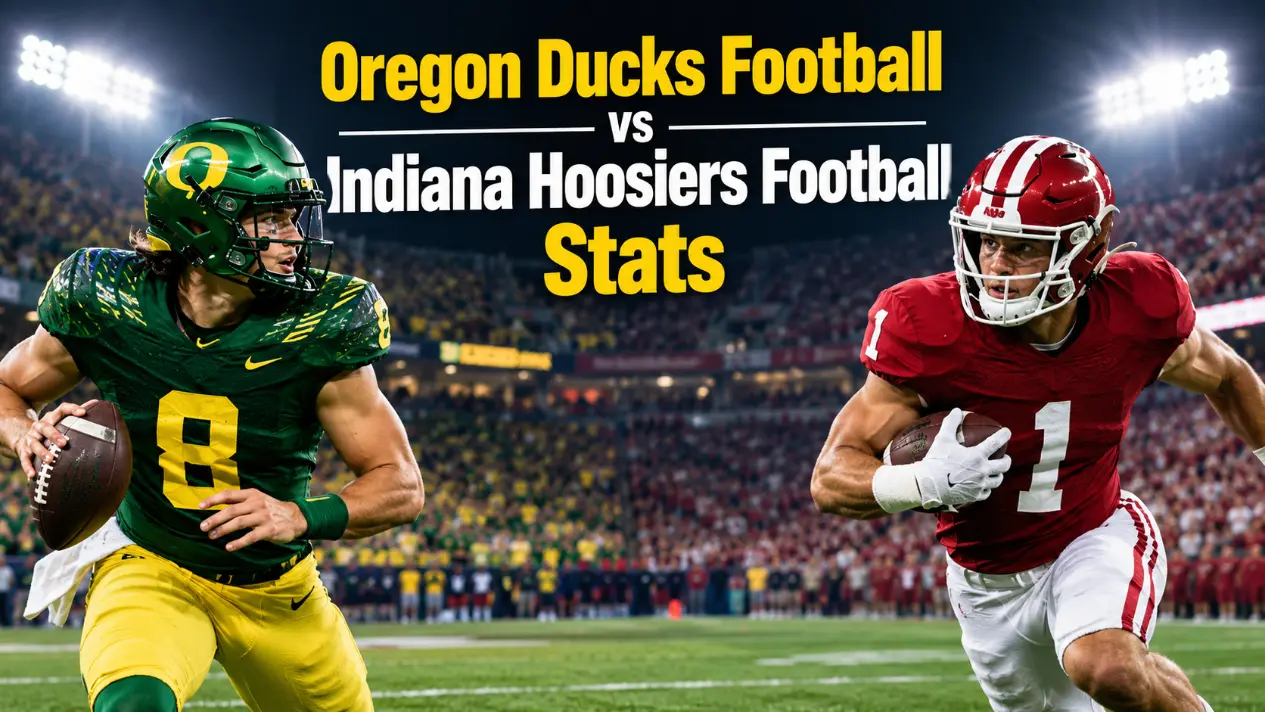
The Oregon Ducks lost 56–22 to the Indiana Hoosiers on January 9, 2026, in the College Football Playoff semifinal at Mercedes-Benz Stadium in Atlanta.
Oregon recorded 378 total yards, including 285 passing yards, while Indiana produced 362 total yards and five passing touchdowns. Fernando Mendoza threw five touchdown passes without an interception.
Key Takeaways
- Indiana defeated Oregon 56–22 in the January 9, 2026, College Football Playoff semifinal.
- Oregon quarterback Dante Moore threw for 285 yards, two touchdowns, and one interception.
- Indiana quarterback Fernando Mendoza completed 17 of 20 passes for 177 yards and five touchdowns.
- Indiana gained 185 rushing yards, compared with Oregon’s 93.
- Indiana’s defense scored on a 25-yard interception return and recovered two Oregon fumbles.
Oregon vs Indiana Final Score and Game Summary
The latest Oregon Ducks football vs Indiana Hoosiers football matchup took place on January 9, 2026, at Mercedes-Benz Stadium in Atlanta, Georgia. Indiana entered the College Football Playoff semifinal unbeaten and continued its championship run with a commanding 56–22 victory over Oregon.
Indiana took control early and scored 35 points in the first half. Oregon answered with a touchdown in the opening quarter but struggled to keep pace as the Hoosiers repeatedly turned scoring opportunities into touchdowns.
The opening play set the tone. Indiana defensive back D’Angelo Ponds intercepted Dante Moore’s pass and returned it 25 yards for a touchdown. That immediate defensive score gave Indiana an early advantage and put Oregon under pressure.
Indiana University Athletics
| Game information | Details |
|---|---|
| Matchup | Oregon Ducks vs. Indiana Hoosiers |
| Date | January 9, 2026 |
| Competition | College Football Playoff semifinal |
| Venue | Mercedes-Benz Stadium, Atlanta |
| Final score | Indiana 56, Oregon 22 |
| Leading passer | Dante Moore, 285 yards |
| Passing touchdowns | Fernando Mendoza, 5 |
Oregon Ducks vs Indiana Hoosiers Team Stats
The team statistics show an interesting contrast. Oregon gained more passing yards and finished with slightly more total offensive yards, but Indiana was more effective at converting its possessions into points.
| Team statistic | Oregon | Indiana |
|---|---|---|
| Final score | 22 | 56 |
| First downs | 20 | 18 |
| Total offensive yards | 378 | 362 |
| Passing yards | 285 | 177 |
| Rushing yards | 93 | 185 |
| Total plays | 66 | 60 |
| Average yards per play | 5.7 | 6.0 |
| Third-down conversions | 8/13 | 11/14 |
| Turnovers lost | 3 | 0 |
| Time of possession | 28:47 | 31:13 |
| Penalties | 5 for 43 yards | 5 for 23 yards |
Source: Official Indiana University Athletics box score.
Oregon finished with 16 more total yards than Indiana, but the Ducks committed three turnovers, including an interception and two lost fumbles. Indiana did not lose a turnover.
The Hoosiers also converted 11 of 14 third-down opportunities. Oregon converted eight of 13. These differences helped Indiana sustain drives and score consistently despite recording fewer total yards.
Stat takeaway: Total yardage alone does not explain a football result. Turnovers, red-zone execution, and scoring efficiency can have a greater impact on the final score.
Quarterback Passing Stats
The quarterback comparison highlights two very different performances. Moore gained more passing yards, while Mendoza delivered substantially more touchdown production and avoided interceptions.
| Quarterback | Completions | Attempts | Passing yards | TDs | INTs |
|---|---|---|---|---|---|
| Dante Moore, Oregon | 24 | 39 | 285 | 2 | 1 |
| Fernando Mendoza, Indiana | 17 | 20 | 177 | 5 | 0 |
Dante Moore’s Passing Performance
Dante Moore completed 24 of 39 passes for 285 yards, two passing touchdowns, and one interception. His longest completion went for 43 yards. He also faced three sacks, which contributed to Oregon’s offensive difficulties.
Moore connected with Jamari Johnson for a 19-yard touchdown in the first quarter. Late in the fourth quarter, he threw a one-yard touchdown pass to Roger Saleapaga.
Although Moore moved the ball through the air, Oregon’s turnovers reduced the value of that production. The Ducks needed more efficient possessions to challenge Indiana’s lead.
Fernando Mendoza’s Passing Performance
Fernando Mendoza completed 17 of 20 passes for 177 yards, five touchdowns, and zero interceptions. His completion rate was 85%, making his passing performance highly efficient.
Mendoza threw touchdown passes to Omar Cooper Jr., Charlie Becker, Elijah Sarratt, and E.J. Williams. Sarratt caught two touchdown passes, while the other three receivers caught one each.
Mendoza’s five passing touchdowns were the defining statistical feature of the game. Indiana did not need a large passing-yard total because it converted its passing opportunities into touchdowns.
Rushing Stats and Leading Ball Carriers
Indiana controlled the ground game, finishing with 185 net rushing yards on 40 attempts. Oregon recorded 93 rushing yards on 26 attempts. Indiana also scored twice on the ground, while Oregon had one rushing touchdown.
| Player | Team | Carries | Rushing yards | Rushing TDs |
|---|---|---|---|---|
| Dierre Hill Jr. | Oregon | 5 | 86 | 0 |
| Jay Harris | Oregon | 16 | 35 | 1 |
| Kaelon Black | Indiana | 12 | 63 | 2 |
| Roman Hemby | Indiana | 17 | 53 | 0 |
| Khobie Martin | Indiana | 4 | 42 | 0 |
Dierre Hill Jr. led Oregon in rushing with 86 yards on five carries. His longest run covered 71 yards, providing one of Oregon’s biggest gains on the ground. Jay Harris added 35 rushing yards and scored Oregon’s rushing touchdown.
For Indiana, Kaelon Black recorded 63 rushing yards and two touchdowns. Roman Hemby added 53 yards on 17 carries, helping Indiana maintain a balanced attack.
Indiana’s 92-yard advantage in net rushing production helped the Hoosiers control the pace and made the offense less dependent on passing volume.
Receiving Stats and Top Playmakers
Oregon’s receiving production was led by Jamari Johnson, while Indiana’s Elijah Sarratt delivered a productive performance with two touchdown catches.
| Receiver | Team | Receptions | Receiving yards | TDs |
|---|---|---|---|---|
| Jamari Johnson | Oregon | 4 | 83 | 1 |
| Jeremiah McClellan | Oregon | 5 | 64 | 0 |
| Jay Harris | Oregon | 3 | 32 | 0 |
| Kenyon Sadiq | Oregon | 5 | 29 | 0 |
| Elijah Sarratt | Indiana | 7 | 75 | 2 |
| Charlie Becker | Indiana | 2 | 48 | 1 |
| Omar Cooper Jr. | Indiana | 3 | 17 | 1 |
| E.J. Williams Jr. | Indiana | 1 | 13 | 1 |
Johnson led Oregon with 83 receiving yards and a touchdown. His 19-yard touchdown reception in the first quarter helped Oregon tie the score at seven points apiece after Indiana’s opening defensive touchdown.
McClellan contributed 64 yards on five catches, while Sadiq recorded five receptions for 29 yards.
Sarratt was Indiana’s leading receiver by both catches and receiving touchdowns. He finished with seven receptions for 75 yards and two scores. Becker added 48 yards and a touchdown, including a 36-yard scoring reception in the second quarter.
Defensive Plays and Turnovers
Indiana’s defense made an immediate impact by scoring on Moore’s opening-drive interception. Ponds returned the pick 25 yards for a touchdown, giving Indiana seven points before its offense completed a scoring drive.
The Hoosiers also recovered two Oregon fumbles. Those additional possessions helped Indiana extend its advantage during the second quarter.
Oregon’s defense had individual contributions as well. Bryce Boettcher recorded 11 total tackles, while Dillon Thieneman finished with 10. However, the Ducks struggled to prevent Indiana from converting third downs and finishing drives.
Indiana’s defense did not need to limit Oregon to a low yardage total to win convincingly. Creating turnovers, scoring directly, and giving the offense favorable field position proved decisive.
Quarter-by-Quarter Scoring Summary
| Quarter | Oregon | Indiana |
|---|---|---|
| First | 7 | 14 |
| Second | 0 | 21 |
| Third | 8 | 7 |
| Fourth | 7 | 14 |
| Final | 22 | 56 |
Indiana led 14–7 after the first quarter and scored three more touchdowns in the second to take a 35–7 halftime lead.
Oregon scored a two-point conversion after Jay Harris’s second-half rushing touchdown, but Indiana continued to answer with touchdowns of its own. The Hoosiers scored 21 points in the fourth quarter’s surrounding scoring sequence? More precisely, Indiana added 14 points in the fourth quarter, while Oregon scored seven. The final margin remained 34 points.
The scoring pattern illustrates why Indiana won comfortably: it established an early lead, created separation before halftime, and kept scoring after Oregon’s attempts to respond.
What the Stats Tell Us About the Game
Three statistical details explain the result.
First, Indiana was much more efficient in the passing game. Mendoza threw five touchdown passes on only 20 attempts, while Moore threw two touchdowns and one interception on 39 attempts.
Second, Indiana won the rushing battle. The Hoosiers gained 185 rushing yards compared with Oregon’s 93. Black’s two rushing touchdowns also added another scoring threat.
Third, turnovers changed the game. Indiana scored on its opening interception and recovered two Oregon fumbles. Oregon finished with three turnovers lost, while Indiana finished with none.
The result shows that passing yards and total offensive yards do not necessarily determine the winner. Indiana combined efficient quarterback play, productive rushing, and defensive takeaways to turn a relatively close yardage comparison into a decisive victory.
FAQs
Who won the latest Oregon vs Indiana football game?
The Indiana Hoosiers defeated the Oregon Ducks 56–22 on January 9, 2026, in the College Football Playoff semifinal at Mercedes-Benz Stadium in Atlanta.
How many passing yards did Dante Moore record?
Dante Moore recorded 285 passing yards for Oregon, completing 24 of 39 passes with two touchdowns and one interception.
How many touchdowns did Fernando Mendoza throw?
Fernando Mendoza threw five touchdown passes against Oregon. He completed 17 of 20 passes for 177 yards without an interception.
Which team had more rushing yards?
Indiana had more rushing yards, finishing with 185 net yards compared with Oregon’s 93. Kaelon Black led Indiana with 63 rushing yards and two touchdowns.
Did Oregon and Indiana play twice in the 2025 season?
Yes. Indiana beat Oregon 30–20 on October 11, 2025, during the regular season, then defeated the Ducks 56–22 in the January 9, 2026, College Football Playoff semifinal. These were separate games with different box scores.
Conclusion
The Oregon Ducks football vs Indiana Hoosiers football stats show that Indiana won through efficient quarterback play, a stronger rushing attack, and game-changing defensive turnovers.
Oregon produced more total yards, but Mendoza’s five touchdown passes and Indiana’s turnover advantage made the difference.
For readers reviewing the matchup, the January playoff game should be kept separate from the October regular-season meeting. For complete scoring details and official individual statistics,

Olivia Harper is a dedicated content creator at WorldofDreamsz.Com sharing powerful insights about dreams, prayers, and biblical meanings. Her writing helps readers discover hidden messages and find direction in their spiritual journey.