NiGHTS into Dreams is a classic 1996 action game developed by Sonic Team and published by Sega for the Sega Saturn.
Set in the dream world of Nightopia, the game follows two teenagers, Claris Sinclair and Elliot Edwards, as they encounter NiGHTS and face the villain Wizeman the Wicked.
Unlike traditional platform games, NiGHTS into Dreams focuses on flying through colorful dream environments rather than running and jumping across platforms. Players guide NiGHTS through looping paths, collect Ideya, defeat enemies, earn points, and complete dream stages.
The game’s aerial movement, imaginative visuals, memorable music, and surreal atmosphere give it a distinct identity.
The combination of dream-inspired storytelling and flight-based gameplay made NiGHTS into Dreams one of the Sega Saturn’s most recognizable titles. Its unique design has also helped it maintain a lasting reputation among retro gaming fans.
Key Takeaways
- NiGHTS into Dreams debuted on the Sega Saturn in 1996.
- It was developed by Sonic Team and published by Sega.
- Yuji Naka served as producer and lead programmer.
- Naoto Ohshima directed the project and designed NiGHTS.
- The story takes place primarily in the dream world of Nightopia.
- Players control NiGHTS while helping Claris Sinclair and Elliot Edwards.
- Flying and aerial movement are central to the gameplay.
- The game later received versions for other platforms, including PlayStation 2, PlayStation 3, Xbox 360, and Windows.
What Is NiGHTS into Dreams?
NiGHTS into Dreams is an action game created by Sega’s Sonic Team. It was designed for the Sega Saturn and became one of the system’s most recognizable original titles.
Unlike a traditional platform game, the experience focuses heavily on aerial movement. Rather than simply running from one side of a level to another, players guide NiGHTS through dream environments, collecting objects, performing movements, and trying to achieve high scores.
The game combines 3D environments with 2D-style gameplay elements, giving it a distinctive presentation for its time. Its unusual structure helped separate it from other action games released during the mid-1990s.
When Was NiGHTS into Dreams Released?
The original game launched on the Sega Saturn in 1996. Release dates differed by region. Sources list the Japanese release in July 1996 and the North American release in August 1996, while European releases followed later that year.
Sega later brought the game to additional platforms. A PlayStation 2 version appeared in Japan in 2008, while an updated version reached Windows, PlayStation 3, and Xbox 360 in 2012.
The Story of NiGHTS into Dreams
The story begins with two teenagers: Claris Sinclair and Elliot Edwards.
Although their individual circumstances differ, both characters experience struggles that affect their confidence and dreams. Their journeys eventually lead them into Nightopia, the game’s dream world.
There they encounter NiGHTS, a rebellious Nightmare who becomes their ally.
The central threat comes from Wizeman the Wicked, the ruler responsible for creating the Nightmares. The conflict revolves around the dream world’s survival and the energy contained within dreams.
The official PlayStation description of the later version summarizes the central objective as helping Elliot and Claris save Nightopia from Wizeman while collecting Ideya and fighting bosses.
Claris Sinclair
Claris is one of the two human protagonists.
Her story is closely connected with confidence and self-expression. She dreams of becoming a singer but struggles with self-doubt. Her journey through Nightopia provides a fantasy setting in which she can confront those emotional barriers.
This gives her storyline a different feel from a simple good-versus-evil adventure.
Elliot Edwards
Elliot is the second main human character.
His storyline also deals with confidence, fear, and personal challenges. Like Claris, he enters the dream world and eventually works with NiGHTS.
The two characters give the game an important emotional layer. The adventure is not only about defeating enemies. It is also about overcoming internal obstacles.
NiGHTS
NiGHTS is the game’s most recognizable character.
The character was designed by Naoto Ohshima, while Yuji Naka served as producer and lead programmer. NiGHTS was intentionally created as an unusual dream-world figure rather than a conventional human hero.
The character’s ability to fly is central to both the story and the game’s mechanics.
That connection between character design and gameplay is one reason NiGHTS remains memorable decades after the original release.
How Does the Gameplay Work?
The easiest way to understand NiGHTS into Dreams is to think of it as a score-focused aerial action game set inside a dream world.
Instead of relying on standard jumping and running, NiGHTS flies through stages. Players can perform loops, collect objects, defeat enemies, and build up their score.
Flying Is the Main Attraction
Flying gives the game its identity.
Players move through dream environments along aerial routes. The controls are designed around smooth movement rather than the precise jumping associated with classic 2D platformers.
The developers’ focus on flight also influenced the design of the Saturn 3D controller. The optional controller included an analog stick and analog triggers that made movement more suitable for NiGHTS.
Collecting Ideya
Ideya is an important gameplay element.
These colored objects represent different aspects of dream energy. Players collect them while moving through each stage.
The 2012 PlayStation version specifically described the objective as collecting Ideya, earning points, and battling bosses across the game’s original dreams.
Building Your Score
Score is a major part of the experience.
Players are encouraged to move efficiently, maintain momentum, collect objects, and perform aerial actions. This means the game can feel very different on a first playthrough compared with repeated attempts.
The first playthrough is about learning.
Later attempts become about optimization.
That score-focused structure gives NiGHTS into Dreams considerable replay value for players who enjoy mastering movement.
What Are Nightopia and the Dream Worlds?
Nightopia is the central dream world where much of the game takes place.
The environment is not designed to behave like an ordinary physical location. Instead, it follows the logic of dreams.
That allows Sonic Team to combine unusual architecture, bright colors, flying paths, fantastical enemies, and surreal environments.
The Seven Original Dreams
The game features seven original dreams in its main adventure. The later HD release retained these original dreams while adding enhanced features.
The stages are divided between the two protagonists.
| Character | Dream stages |
| Claris | Spring Valley, Mystic Forest, Soft Museum, Twin Seeds. |
| Elliot | Splash Garden, Frozen Bell, Stick Canyon, Twin Seeds. |
The final stage, Twin Seeds, connects the two storylines.
This structure gives players a reason to experience the game from both perspectives.
Why the Dream Setting Matters
The dream setting allows gameplay mechanics to feel natural.
Flying through the sky might seem strange in a realistic action game. In Nightopia, however, it makes perfect sense.
This is one of the game’s strongest design choices: the setting supports the mechanics instead of simply decorating them.
Who Developed NiGHTS into Dreams?
The game came from a major group of Sonic Team developers.
Its development is strongly associated with three important names: Yuji Naka, Naoto Ohshima, and Takashi Iizuka. Naka served as producer and programmer, Ohshima was director and character designer, and Iizuka worked as lead game designer.
Yuji Naka
Yuji Naka was already closely associated with Sega and Sonic Team when NiGHTS into Dreams entered development.
For this project, the team wanted to explore something beyond another conventional Sonic title. The concept became a new intellectual property centered around flight and dreams.
Naoto Ohshima
Naoto Ohshima played an important role in the game’s creative direction.
He designed NiGHTS and helped shape the character’s distinctive appearance. Historical accounts of development describe the concept as an angel-like figure capable of flying.
Takashi Iizuka
Takashi Iizuka contributed to the game’s design and later became an important figure in the Sonic franchise.
His work on NiGHTS into Dreams helped establish his connection with Sonic Team’s major projects.
Why Was NiGHTS into Dreams Important for the Sega Saturn?
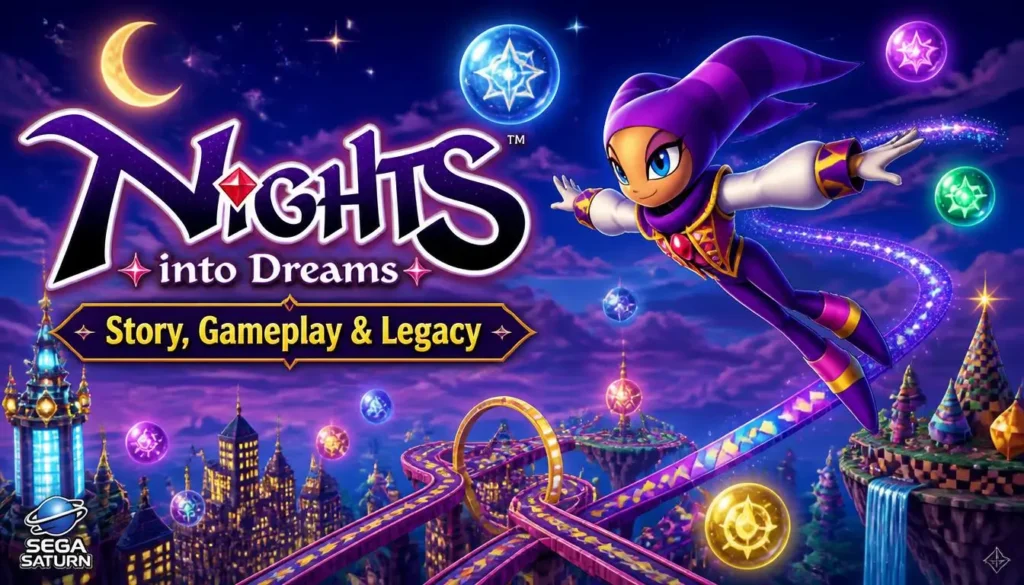
The Sega Saturn faced intense competition during the 1990s.
At a time when 3D gaming was rapidly becoming more important, Sega needed distinctive software that could demonstrate what its hardware could do.
NiGHTS into Dreams was one such showcase.
Its combination of 3D environments, aerial movement, colorful visuals, and an unusual control system made it stand out.
The game was also released alongside an optional Saturn 3D Control Pad, which was particularly suited to NiGHTS’s movement.
NiGHTS vs. Traditional Platform Games
| Feature | Traditional platformer | NiGHTS into Dreams |
| Main movement | Running and jumping | Flying |
| Level progression | Often linear | Aerial routes and loops |
| Main goal | Reach the end | Score, collect, and progress |
| Camera | Often side or fixed | Dynamic 3D presentation |
| Replay focus | Completion | High-score optimization |
| Setting | Physical world | Dream world |
This difference helps explain why the game developed such a dedicated following.
NiGHTS into Dreams Versions and Re-Releases
The original Sega Saturn release was not the end of the game’s history.
Sega Saturn
The Saturn version is the original experience and remains the version most closely associated with the game’s 1996 debut.
Its release was accompanied in some markets by the Saturn 3D Control Pad, which was designed to improve analog movement.
PlayStation 2
A PlayStation 2 version was released in Japan in 2008.
This version helped introduce the game to players who had missed it during the Saturn era.
HD Versions
In 2012, Sega released an updated version for modern platforms of the period.
The HD version included enhanced graphics, achievements, leaderboards, and the original seven dreams. It also included playable content connected with Christmas NiGHTS.
The ESRB lists versions for Windows PC, PlayStation 3, Xbox 360, and Xbox One, with an E for Everyone rating for the listed release.
Because storefront availability can change over time, players should check the current platform store before assuming a particular digital version is still available.
Christmas NiGHTS and the Game’s Legacy
One of the most interesting additions to the franchise was Christmas NiGHTS into Dreams, a Christmas-themed release connected to the original game.
It appeared in 1996, shortly after the main game.
Rather than being a full sequel, it functioned as a special Christmas-themed experience and helped keep NiGHTS visible during the Saturn era.
Why Fans Still Remember the Game
Several qualities explain the game’s long-term reputation:
- Distinctive movement >Flying feels central rather than secondary.
- Dream-inspired design > The setting gives the developers unusual creative freedom.
- Memorable character design > NiGHTS has an instantly recognizable appearance.
- Score-based replayability > Players can keep improving their performance.
- Strong atmosphere > Music, environments, and movement work together.
- Sega history > It represents an important part of the Saturn era.
- Influence on later Sonic Team work > Several members of the development team continued working on major Sega projects.
The game also received strong critical attention. MobyGames’ historical aggregation lists a 91% critics’ score based on 34 reviews for the Saturn version.
Is NiGHTS into Dreams Worth Playing Today?
For retro gamers, the answer depends on what you want from a game.
If you prefer modern open-world games with extensive progression systems, NiGHTS into Dreams can feel unusual at first.
However, if you enjoy arcade-style scoring, experimental gameplay, Sega history, retro 3D graphics, or imaginative worlds, it remains an interesting experience.
Reasons to Try It
You enjoy Sega history:
NiGHTS is one of the most distinctive original properties associated with the Saturn.
Like high-score games:
The scoring system rewards repeated play and mastery.
Enjoy unusual game mechanics:
The focus on flying separates it from conventional platformers.
You like dreamlike fantasy:
Nightopia provides a colorful and surreal setting.
Reasons It May Not Be for Everyone
The game can initially feel less straightforward than modern action titles.
Its scoring mechanics also become more important as you replay stages. Someone looking only for a simple story-driven adventure may not immediately appreciate its design.
The best way to approach it is to understand that mastery is part of the experience.
FAQs:
Is NiGHTS into Dreams a Sonic game?
No. NiGHTS into Dreams is a separate Sega franchise developed by Sonic Team. Although many of the developers were closely associated with Sonic, NiGHTS is its own intellectual property.
What console was NiGHTS into Dreams originally released on?
The original game was released for the Sega Saturn in 1996. It later received versions for platforms including PlayStation 2, Windows, PlayStation 3, and Xbox 360.
Who created NiGHTS into Dreams?
The game was developed by Sonic Team. Yuji Naka was producer and lead programmer, Naoto Ohshima was director and character designer, and Takashi Iizuka served as lead game designer.
What is the main goal in NiGHTS into Dreams?
Players control NiGHTS through dream stages, collecting Ideya, defeating enemies, earning points, and progressing through the story. The game places a strong emphasis on aerial movement and score improvement.
Is NiGHTS into Dreams still worth playing?
Yes, especially for fans of retro Sega games, arcade-style scoring, experimental 3D gameplay, and dream-inspired worlds. Its unusual mechanics may require an adjustment period, but that uniqueness is also one of its biggest strengths.
Conclusion:
NiGHTS into Dreams remains an important part of Sega’s gaming history because it dared to do something different. Instead of building another conventional platform game, Sonic Team created a world where flying became the main form of movement and dreams became the foundation for both story and gameplay.
The result was a visually distinctive Sega Saturn title built around NiGHTS, Claris, Elliot, Nightopia, Ideya, and the conflict with Wizeman. Its original release in 1996 was followed by later versions that introduced the game to new audiences.
What makes the game especially memorable is its design philosophy. Movement, atmosphere, story, and setting all point toward the same idea: the freedom of flight inside a dream.
For modern players, it may not behave like a typical contemporary action game. Yet that difference is exactly why NiGHTS into Dreams continues to stand out. It is a fascinating example of how experimental game design can create something that remains recognizable long after its original hardware has faded from the mainstream.
Read More Posts:
- I Just Threw Out the Love of My Dreams Lyrics: Story & Meaning
- To the Stars Who Listen and the Dreams That Are Answered Guide
- How Long Do Dreams Last? Science, Sleep, and Dream Time

Daniel Brooks is a passionate writer at WorldofDreamsz.Com specializing in dream meanings and spiritual interpretations. He aims to provide easy-to-understand insights that help readers find meaning and purpose in everyday life.