Some dreams feel unusually vivid and intense, especially when your body is fighting an illness. Fever dreams can involve strange places, distorted objects, unfamiliar faces, endless spaces, or situations that feel confusing and emotionally powerful.
You may wake up feeling unsettled and remember details that would normally fade quickly.
Fever can influence sleep, body temperature, mood, and brain activity. These changes may disturb normal sleep patterns and contribute to vivid or unusual dreams.
Research has found that dreams during fever can contain more bizarre, negative, and health-related themes than typical dreams.
The experience does not automatically point to a hidden emotional or spiritual message.
Physical discomfort, disrupted sleep, elevated temperature, and stress can all shape dream content. Personal feelings and beliefs may also influence how someone interprets the experience.
Key Takeaways
- Fever can change sleep quality and dream experiences.
- Fever dreams often feel unusually vivid, bizarre, or threatening.
- Heat sensations may become part of the dream itself.
- Not every fever dream has a symbolic or spiritual meaning.
- Your emotions, illness, stress, and recent experiences may influence the dream.
- Spiritual interpretations can be personally meaningful, but they are subjective rather than scientifically proven.
- A strange dream is different from a medical emergency caused by a high fever.
What Are Fever Dreams?
A fever dream is a dream that occurs while you have a fever or are experiencing an illness that affects your sleep.
People often describe these dreams as unusually intense. They may involve strange spaces, distorted objects, impossible movements, repetitive situations, threatening figures, or a powerful feeling that something is wrong.
Interestingly, scientific research supports some of these common reports. In a 2020 study published in Frontiers in Psychology, researchers analyzed reports from people who had experienced dreams during fever.
Compared with ordinary dreams, fever dreams were more bizarre, more negatively toned, and more likely to include health-related and temperature-related content.
A later review found that the research base remains small. Only a few studies met the review’s criteria, and the available evidence was considered moderate to low quality. That means researchers have identified a pattern, but there is still much to learn about exactly why fever changes dream experiences.
Fever Dreams vs. Nightmares
The terms are related, but they are not identical.
| Fever Dream | Nightmare |
| Happens during a fever or illness | Can happen without illness. |
| May be bizarre or confusing | Usually involves fear or distress. |
| Can include heat or physical sensations | Often centers on threats or danger. |
| May be vivid without being terrifying | Usually causes strong negative emotion. |
| Can reflect physical discomfort | Can be linked with stress, trauma, or other factors. |
A fever dream can certainly become a nightmare. But a strange dream during an illness does not automatically qualify as a nightmare.
Why Do Fever Dreams Happen?
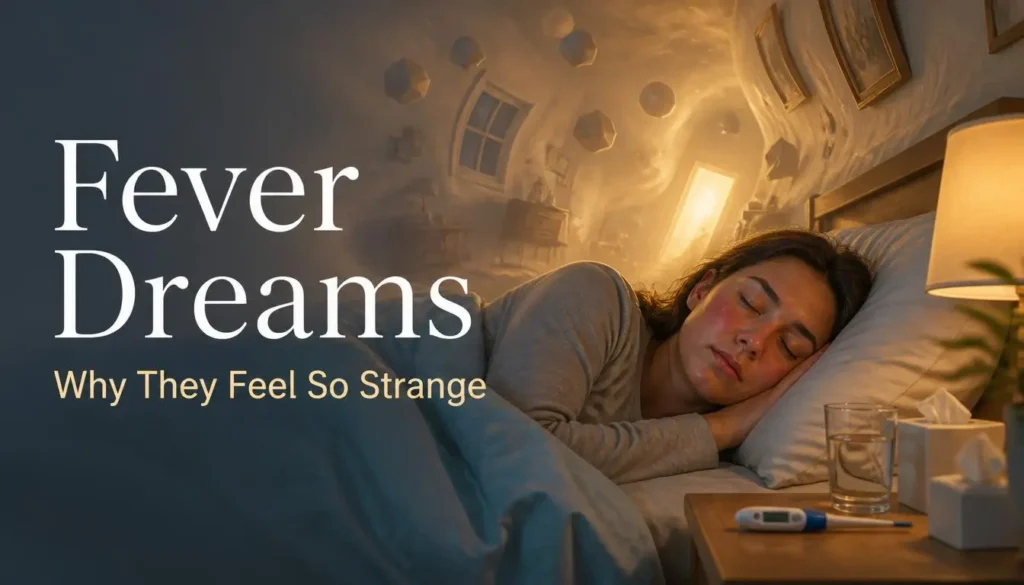
There is no single explanation. Fever changes several conditions that normally support stable sleep, and those changes may affect how dreams are experienced and remembered.
Fever Can Disrupt Sleep
Older experimental research found that fever was associated with more waking and reduced slow-wave and REM sleep. More recent reviews also point to disrupted REM sleep as one possible factor in unusual fever dreams.
When sleep becomes fragmented, you may wake up several times during the night. That can make a dream easier to remember because dream recall is strongly affected by when and how you wake.
In other words, the dream may not necessarily be dramatically different in every respect. You may simply remember an unusual dream more clearly because your sleep was interrupted.
Your Brain Notices Heat
During a fever, your body temperature rises above its normal range. That physical sensation does not necessarily stay outside the dream.
Researchers studying fever dreams found more references to temperature and heat than in comparison dreams. One explanation is that the brain may incorporate internal physical sensations into the dream narrative.
For example, you might dream about:
- Standing beside a huge fire.
- Being trapped in a desert.
- Entering a room that keeps getting hotter.
- Wearing heavy clothing in extreme heat.
- Trying to escape a burning building.
- Swimming in warm or boiling water.
The dream does not prove that the scene has a symbolic meaning. It may simply be the dreaming brain making sense of the physical sensation of being hot.
Illness Can Affect Mood and Thinking
Being sick is stressful for the body. Fever may occur alongside weakness, headaches, muscle aches, dehydration, poor sleep, and other symptoms. Illness can therefore influence both your physical state and your emotional state.
Those changes matter because dreams often contain elements connected with waking experiences.
The National Institute of Neurological Disorders and Stroke notes that dreams can involve events and emotions from waking life and that dreams are often especially vivid during REM sleep.
Your Dream Logic May Become More Unusual
Normal dreams already have unusual logic. Fever may make the overall experience feel even stranger.
The 2020 fever-dream study found greater bizarreness in fever dreams, including unusual spatial experiences and strange transformations.
This may help explain why people describe fever dreams as feeling “too real” while also being impossible to understand.
Common Fever Dream Themes and What They May Reflect
There is no universal fever dream dictionary. A dream about fire does not automatically mean the same thing for everyone.
Still, certain themes can be useful starting points when you reflect on your own experience.
Feeling Trapped
Dreaming that you cannot leave a room, building, vehicle, or strange place may reflect physical discomfort or emotional helplessness.
When you are sick, your normal activities are limited. You may be stuck in bed, unable to work, travel, exercise, or socialize.
Possible psychological reflection: frustration, vulnerability, loss of control, or simply the feeling of being physically confined by illness.
Being Chased
A chase dream can feel especially frightening during a fever.
Psychologically, the threatening figure may represent nothing more mysterious than your brain creating a story around fear and physical discomfort. If you were already anxious before becoming sick, that anxiety may also appear in the dream.
Possible reflection: stress, fear, pressure, or a desire to escape an uncomfortable situation.
Endless Rooms or Distorted Spaces
Some fever dreams involve huge rooms, tiny rooms, moving walls, giant objects, or spaces that seem to change size.
This matches themes reported in fever-dream research, where spatial distortions appeared in dream reports.
Rather than assuming a fixed symbolic meaning, consider how the distortion felt.
Did it make you feel:
- Confused?
- Overwhelmed?
- Curious?
- Trapped?
- Powerless?
- Safe despite the strange setting?
Your emotional reaction may provide more useful context than the object itself.
Fire, Heat, or Burning
Heat is particularly interesting in fever dreams because it can have a direct physical connection to fever.
If you dream about fire while your body feels unusually hot, the dream may be incorporating that sensation.
From a symbolic perspective, however, fire can also represent transformation, anger, energy, danger, purification, or change in different cultural and spiritual traditions.
These interpretations should be treated as personal or cultural symbolism, not medical or scientific conclusions.
Repeating the Same Situation
Some people describe fever dreams as repetitive. The same action may happen again and again, or the dream may seem to move through a loop.
This can feel disturbing because ordinary dream narratives already lack the structure of waking life.
If the repetition connects with something happening in your life, you can reflect on it. But repetition alone does not prove that your subconscious is sending a specific message.
The Psychological Meaning of Fever Dreams
Dream interpretation becomes more useful when it starts with the dreamer’s actual life rather than a fixed dictionary.
The Continuity Hypothesis
One useful psychological framework is the continuity hypothesis of dreaming. In simple terms, it suggests that dreams often reflect waking-life concerns, emotions, experiences, and thoughts.
Fever-dream research has found results that fit this idea. Because illness changes mood, physical sensations, and cognition, those changes may become part of dream content.
For example:
| Waking experience | Possible dream expression |
| Feeling physically trapped in bed | Being trapped somewhere. |
| Feeling overheated | Fire, desert, burning rooms. |
| Anxiety about being sick | Threats or frightening figures. |
| Confusion from poor sleep | Strange or illogical environments. |
| Headache or body discomfort | Physical danger in the dream. |
| Worry about health | Hospitals, doctors, illness themes. |
These are possibilities, not rules.
Your Feelings Matter More Than a Dream Dictionary
Suppose two people dream about a hospital during a fever.
One person works in healthcare and feels calm around hospitals. Another person fears hospitals deeply.
The same image can therefore produce very different meanings.
When interpreting a fever dream, ask:
- What happened?
- What emotion was strongest?
- What was happening in my life before I became sick?
- Did the dream include sensations I was physically experiencing?
- What part of the dream stayed with me after waking?
This approach is more personal and usually more useful than searching for one universal definition.
Spiritual Meaning of Fever Dreams
Some people view unusual dreams as spiritually meaningful. Across religious and cultural traditions, dreams have sometimes been treated as sources of reflection, warning, guidance, or symbolic communication.
However, there is an important distinction between spiritual belief and scientific evidence.
There is no reliable scientific evidence showing that fever dreams are automatically supernatural messages. Fever itself can alter sleep and dream experiences, providing a strong physical reason for unusually vivid or strange dreams.
That does not mean a spiritual interpretation is meaningless to someone who holds spiritual beliefs.
A balanced approach is to ask what the dream means to you rather than claiming that it predicts the future.
Possible Spiritual Themes
If you approach dreams from a spiritual perspective, a fever dream might encourage reflection on themes such as:
- Rest and recovery
- Vulnerability
- Letting go
- Emotional cleansing
- Personal transformation
- Fear and trust
- The need to slow down
- Reconnecting with faith or personal values
These are interpretive possibilities, not proven messages.
If a dream brings comfort, prayer, reflection, or a renewed sense of purpose, that personal response can be meaningful without requiring the dream to be treated as a supernatural prediction.
Why Fever Dreams Feel So Real
A vivid dream can sometimes feel almost indistinguishable from reality.
Part of the reason is that dreaming involves active brain processes rather than a simple “off” state. Dreams can contain perception, emotion, memory, and a strong sense of being present inside an experience.
Researchers have even demonstrated two-way communication with some lucid dreamers during laboratory-confirmed REM sleep, showing that people can maintain certain forms of perception and communication while dreaming.
Fever may add another layer.
You are experiencing real physical sensations while your brain is creating a dream. If your body feels hot, weak, uncomfortable, or restless, those sensations may become woven into the dream.
That combination can make the dream feel unusually convincing.
Fever Dreams vs. Fever Hallucinations
These experiences should not always be treated as the same thing.
A fever dream occurs during sleep. A hallucination involves perceiving something while awake that is not actually present.
Severe illness, high fever, dehydration, medications, sleep deprivation, and other medical factors can affect mental status. Confusion or unusual behavior during a fever can require medical attention, particularly when it is severe or sudden.
If you are awake and seeing, hearing, or experiencing things that other people cannot perceive, do not automatically assume it is a spiritual experience or an ordinary dream. Consider your physical condition and seek appropriate medical advice.
When a Fever Needs Medical Attention
The dream itself is usually less important than the illness causing the fever.
For adults, Mayo Clinic advises contacting a healthcare provider for a temperature of 103°F (39.4°C) or higher, and immediate medical attention may be needed when fever occurs with symptoms such as severe headache, stiff neck, confusion, breathing difficulty, chest pain, persistent vomiting, or seizures.
MedlinePlus also advises medical attention for adults with fever that remains at or rises above 103°F, lasts more than 48–72 hours, or reaches 105°F or higher.
A fever accompanied by confusion, difficulty waking, seizures, severe breathing problems, or other emergency symptoms should be treated as a medical concern rather than simply a dream-interpretation question.
How to Handle Disturbing Fever Dreams
If you wake from an intense dream while sick, the priority is your physical recovery.
Focus on Rest
Your body needs time to recover from illness. Avoid treating a frightening dream as something you must immediately solve.
Stay Hydrated
Fever can increase fluid needs, and dehydration can become a concern during illness. MedlinePlus recommends paying attention to fluid intake when someone has a fever, vomiting, or diarrhea.
Make Your Sleep Environment Comfortable
A quiet, comfortable room may make it easier to sleep. Excessive heat can also interfere with sleep quality, so avoid making the room unnecessarily warm.
Research on environmental heat shows that higher bedroom temperatures can reduce sleep quality and alter sleep patterns.
Write Down the Dream
If you want to understand the dream later, record a few details:
- What happened?
- Who appeared?
- What did you feel?
- What physical sensations did you notice?
- What was happening in your life before the illness?
Do this after you are comfortable and alert.
Do Not Assume the Worst
A frightening fever dream does not automatically predict something bad.
It may simply be the result of an unusual combination of illness, disrupted sleep, physical sensations, emotional stress, and dream activity.
What Fever Dreams May Tell You About Your Emotional State
A fever dream can sometimes highlight emotional themes that were already present before you became sick.
For example, someone under heavy work pressure might dream about being chased. Someone worried about an illness might dream about hospitals. Someone feeling powerless may dream about being unable to move.
But interpretation should remain flexible.
The dream is not a diagnostic test. It cannot reliably tell you that you have anxiety, trauma, depression, or another mental health condition.
Instead, use it as a prompt for reflection.
A useful question is:
“What feeling from this dream seems familiar in my waking life?”
That question often leads to more meaningful insight than asking what a particular symbol “always” means.
FAQs:
Are fever dreams real?
Yes. Fever dreams are a recognized subjective experience, and research has found differences between dreams reported during fever and ordinary dreams. However, researchers still have limited evidence about exactly how fever produces these changes.
Why are fever dreams so weird?
Fever can disrupt sleep and affect cognition and mood. Research suggests fever dreams tend to be more bizarre and negatively toned, and they may contain more heat- and health-related content.
Do fever dreams have a meaning?
They can have personal meaning, but there is no scientifically proven universal meaning for a particular fever-dream symbol. Your emotions, recent experiences, physical sensations, and cultural or spiritual beliefs may all influence how you interpret the dream.
Can fever cause nightmares?
Fever can be associated with more negative and emotionally intense dreams. However, a fever dream is not necessarily a nightmare. Some fever dreams may simply feel strange, vivid, or confusing rather than frightening.
Should I worry about a fever dream?
Usually, the dream itself is not the main concern. Pay attention to the fever and your other symptoms. For adults, seek medical advice for a fever of 103°F (39.4°C) or higher, and get urgent medical attention if fever occurs with confusion, difficulty breathing, seizures, severe headache, stiff neck, or other serious symptoms.
Conclusion:
Fever dreams can be among the strangest dreams a person experiences. They may feel vivid, confusing, repetitive, frightening, or almost surreal.
Research suggests that these dreams can differ from ordinary dreams, with more bizarre content, more negative emotions, and more references to heat and health.
The most practical explanation is that several factors may overlap. Fever can disturb sleep, change body sensations, affect mood, and influence cognition.
Your dreaming brain may then weave those physical and emotional experiences into an unusual story.
If you enjoy dream interpretation, you can still explore the personal or spiritual meaning of a fever dream. Just keep the distinction clear: symbolism is subjective, while the physical effects of fever and disrupted sleep have scientific support.
Most importantly, do not let dream interpretation distract you from your health. If a fever is high, persistent, or accompanied by confusion, breathing problems, severe headache, stiff neck, seizures, or other serious symptoms, seek medical care.
Read More Posts:
- Have You Seen This Man in Your Dreams? Mystery Explained Guide
- Good Night Sweet Dreams: Romance, and Sweet Messages 2026
- Dreams Onyx Resort & Spa: Resort Review and Booking Tips

Daniel Brooks is a passionate writer at WorldofDreamsz.Com specializing in dream meanings and spiritual interpretations. He aims to provide easy-to-understand insights that help readers find meaning and purpose in everyday life.