“Boulevard of Broken Dreams” by Green Day is a song about loneliness, isolation, uncertainty, and the struggle to find direction.
Released in 2004 as part of the album American Idiot, the song follows Jesus of Suburbia, a fictional character experiencing life away from the familiar world he once knew.
The song paints a picture of someone moving forward alone while searching for a place to belong. Its empty streets and broken-dream imagery reflect emotional disconnection, lost expectations, and the challenges of finding your identity.
The Boulevard of Broken Dreams lyrics are closely connected to the larger story of American Idiot. They capture a quieter and more reflective moment in the character’s journey, moving away from rebellion and toward uncertainty and self-discovery.
The song was written by Green Day, with Billie Joe Armstrong drawing inspiration from his experience of spending time alone in New York.
Its emotional message and memorable sound helped make it one of the band’s most recognized songs.
Key Takeaways
- “Boulevard of Broken Dreams” is performed by Green Day.
- It appears on the 2004 album American Idiot.
- The song explores loneliness, independence, uncertainty, and alienation.
- Billie Joe Armstrong wrote the lyrics.
- The song is connected to the American Idiot character Jesus of Suburbia.
- Armstrong has said he wrote the song while spending time alone in New York.
- It won Record of the Year at the 2006 Grammy Awards.
- The full copyrighted lyrics should be read through an authorized lyrics provider rather than reproduced here.
What Is “Boulevard of Broken Dreams” About?
At its core, “Boulevard of Broken Dreams” is about walking through life alone while trying to understand where you belong.
The narrator describes a solitary journey through an empty urban landscape. The road becomes more than a physical path. Instead, it represents a personal direction in life.
That idea gives the song its emotional power.
Rather than presenting loneliness as a temporary inconvenience, Green Day makes it feel like part of the character’s identity. He is separated from other people, yet he continues moving. Therefore, the song balances sadness with determination.
Loneliness and Independence
One of the strongest ideas in the song is the difference between being alone and choosing independence.
The narrator does not appear completely comfortable with isolation. At the same time, he keeps walking rather than turning back.
That tension is important. Someone can feel lonely while still believing that their current path is necessary.
For many listeners, this makes the song relatable to experiences such as:
- Moving to a new city
- Ending a relationship
- Leaving home
- Starting college
- Changing careers
- Feeling disconnected from friends
- Searching for personal identity
The lyrics create a broad emotional situation rather than describing one specific real-life event.
The Connection to American Idiot
“Boulevard of Broken Dreams” is not an isolated Green Day song. It forms part of the larger narrative of American Idiot, the band’s seventh studio album, released in September 2004.
The track appears as the fourth song on the standard album sequence.
American Idiot is widely understood as a concept album with recurring characters and themes.
Who Is Jesus of Suburbia?
The song is associated with the album’s central fictional character, Jesus of Suburbia.
Green Day’s own song notes explain that “Boulevard of Broken Dreams” represents what this character experiences after moving beyond his familiar environment and entering a world where he feels isolated.
This context changes how the song can be understood.
Without the album’s storyline, the song sounds like a personal reflection about loneliness. Within American Idiot, however, it becomes part of a larger coming-of-age journey.
The character is questioning the world around him. He is also questioning himself.
From Rebellion to Isolation
The broader American Idiot story involves rebellion, frustration, identity, and escape.
“Boulevard of Broken Dreams” represents a quieter stage of that journey.
Instead of shouting against the world, the narrator is walking through it alone.
That shift creates an important contrast. Earlier anger can eventually lead to uncertainty. Once someone leaves behind familiar beliefs, people, or places, freedom can feel lonely.
Who Wrote “Boulevard of Broken Dreams”?
The song was written by the members of Green Day, with Billie Joe Armstrong responsible for the lyrics.
The band’s official song information credits Billie Joe Armstrong for the words and Armstrong, Mike Dirnt, and Tré Cool for the music. Rob Cavallo and Green Day handled production.
Green Day consists of Billie Joe Armstrong, Mike Dirnt, and Tré Cool.
Billie Joe Armstrong’s Inspiration
One of the most useful pieces of background comes from Armstrong himself.
According to Green Day’s official song notes, Armstrong wrote the song while spending time in New York. He described being alone and unfamiliar with the city, particularly the Lower East Side.
This detail helps explain the song’s strong sense of movement through an unfamiliar city.
However, it would be too simple to say that the song is literally a diary entry about New York. The experience appears to have helped inspire the emotional atmosphere, while the finished song became part of the fictional story of Jesus of Suburbia.
That distinction matters.
Verified fact: Armstrong said his time alone in New York helped inspire the song.
Interpretation: The song transforms that experience into a broader story about alienation and searching for direction.
“Boulevard of Broken Dreams” Lyrics Meaning
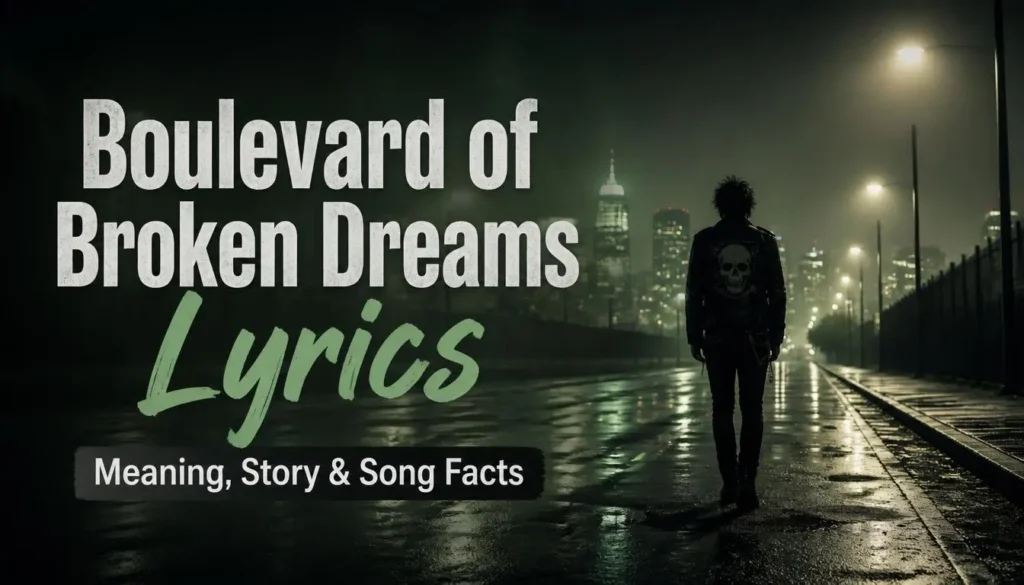
Because the complete lyrics are copyrighted, they are not reproduced here. Instead, the following sections explain the major ideas conveyed by the song.
The Lonely Road
The road is the central image.
A road normally represents movement, possibility, and progress. In this song, however, the road is also empty and lonely.
That combination creates a powerful contrast.
The narrator is going somewhere, but he does not know exactly where the journey ends. As a result, movement does not automatically bring certainty.
This can reflect real-life situations where a person knows they must move forward but has not yet discovered their destination.
The Empty City
The city imagery adds another layer.
Cities are normally associated with crowds, activity, lights, and connection. Yet the narrator experiences the city as empty.
That contrast communicates emotional isolation.
A person can be surrounded by thousands of people and still feel completely alone. In fact, the urban setting makes the loneliness stronger because connection appears to be everywhere but remains out of reach.
The Broken Dream
The title itself is symbolic.
A “broken dream” can represent a goal that did not happen, a relationship that ended, an expectation that failed, or an identity that no longer fits.
Importantly, the song does not define one specific broken dream.
That openness allows listeners to connect the phrase with their own experiences.
Someone might hear it as a song about heartbreak. Another listener may hear a story about leaving home. Someone else may connect it to disappointment or feeling lost.
The song works because the metaphor is broad.
Major Themes in the Song
Several themes overlap throughout “Boulevard of Broken Dreams.”
| Theme | What it represents |
| Loneliness | Feeling disconnected from others. |
| Independence | Continuing forward without relying on others. |
| Uncertainty | Not knowing where life is heading. |
| Identity | Trying to understand who you are. |
| Disappointment | Living after expectations fail. |
| Isolation | Feeling separate even in a populated world. |
| Hope | Continuing the journey despite uncertainty. |
Loneliness vs. Solitude
One useful distinction is between loneliness and solitude.
Solitude means being alone. Loneliness means feeling emotionally disconnected.
The song leans strongly toward loneliness because the narrator’s isolation is presented as something emotionally difficult.
Still, there is also a degree of independence.
That mixture is one reason the song feels more complex than a simple “sad song.”
Searching for Identity
The character’s journey can also be understood as a search for identity.
When people leave behind familiar surroundings, they often discover that independence creates new questions.
Who am I now?
Where do I belong?
What happens if the life I expected is no longer possible?
The song does not provide easy answers. Instead, it captures the uncertainty of asking those questions while continuing forward.
Why Does the Song Sound So Sad?
The emotional effect comes from more than the lyrics.
The production and arrangement help create a feeling of distance and isolation. The song is slower and more atmospheric than many of Green Day’s aggressive punk-rock tracks.
Musical Contrast
Green Day is known for energetic guitar-driven rock, but this track uses a more restrained approach.
The opening establishes a reflective mood. As the song develops, the instrumentation grows while maintaining its melancholy character.
This creates a sense of emotional expansion.
The music begins with solitude and gradually becomes larger without completely removing the feeling of loneliness.
The Role of the Guitar
The guitar sound is particularly important.
It gives the song a rock identity while maintaining a spacious, almost cinematic quality.
That combination helped the track reach listeners who might not normally consider themselves punk-rock fans.
In other words, the song sits between alternative rock, punk-influenced rock, and the power-ballad tradition.
When Was “Boulevard of Broken Dreams” Released?
The song first appeared on American Idiot, which was released on September 21, 2004. It was subsequently issued as a single in late 2004.
Green Day’s official discography lists the single as the second single from American Idiot.
Apple Music also lists the original album release date as September 21, 2004.
Song Information
| Detail | Information |
| Artist | Green Day |
| Album | American Idiot |
| Album release | September 21, 2004 |
| Songwriter | Billie Joe Armstrong, Mike Dirnt, Tré Cool |
| Producer | Rob Cavallo and Green Day |
| Genre | Rock / punk-influenced alternative rock |
| Length | About 4 minutes 20 seconds |
| Single | Second single from American Idiot |
| Grammy | Record of the Year, 2006 |
The exact release-date listings can vary slightly depending on whether a source refers to the album, single, or particular market.
Therefore, the safest distinction is that the song appeared on the September 2004 album and was released as a single later that year.
Awards and Cultural Impact
“Boulevard of Broken Dreams” became one of Green Day’s most successful songs.
The Recording Academy confirms that Green Day won the 2006 Grammy Award for Record of the Year for the song.
The credited producers were Rob Cavallo and Green Day, with Chris Lord-Alge and Doug McKean credited as engineers and mixers.
Recording Academy recognition helped establish the song as more than a commercial rock hit.
Why Did It Connect With So Many People?
The answer may be its emotional simplicity.
The song describes a feeling that does not require a specific age, location, or lifestyle.
You do not have to be a punk-rock fan to understand what it feels like to walk forward while feeling alone.
That universal emotional core helped the song cross genre boundaries.
“Boulevard of Broken Dreams” vs. Other American Idiot Songs
The song becomes even clearer when compared with other tracks from the album.
| Song | Primary emotional focus |
| “American Idiot” | Anger and political/social frustration |
| “Holiday” | Rebellion and criticism |
| “Boulevard of Broken Dreams” | Isolation and uncertainty |
| “Wake Me Up When September Ends” | Grief and memory |
| “Jesus of Suburbia” | Identity and rebellion |
| “Homecoming” | Change and self-discovery |
This comparison shows why “Boulevard of Broken Dreams” is so important to the album.
It slows the story down.
After the louder moments of rebellion, the listener enters a more introspective space. The character is no longer simply fighting against something. He is confronting what it means to be alone.
What Does the Title Mean?
The phrase “Boulevard of Broken Dreams” can be interpreted as an imaginary place where disappointed hopes and abandoned expectations come together.
A boulevard is a public road. A dream is private and personal.
Putting the two ideas together creates an interesting metaphor.
It suggests that personal disappointment can become part of a larger human experience.
Everyone has dreams.
Not every dream survives.
Therefore, the “boulevard” can be viewed as a symbolic landscape populated by people carrying different forms of disappointment.
This is an interpretation rather than a confirmed single meaning from the songwriter. The song’s openness is part of what makes the title memorable.
Is “Boulevard of Broken Dreams” a Love Song?
Not primarily.
Some listeners interpret the song through the lens of romantic heartbreak because its themes of loneliness and loss can fit a breakup.
However, the song’s established connection to American Idiot points toward a broader story about alienation, identity, and the journey of Jesus of Suburbia. Green Day’s own notes specifically describe the character’s loneliness after entering the wider world.
So, while a breakup interpretation is possible, it is not the only or necessarily the central interpretation.
A Better Way to Understand It
Think of the song as being about losing a sense of belonging.
That can happen after:
- A breakup
- Leaving home
- Losing friends
- Moving somewhere unfamiliar
- Rejecting an old identity
- Experiencing major disappointment
- Entering adulthood
The song gives listeners room to bring their own experiences into the story.
Where Can You Read the Full Lyrics?
If you are specifically searching for the complete “Boulevard of Broken Dreams” lyrics, the best option is to use an authorized lyrics service or an official music platform.
Provides verified song information, including the album, credits, and background.
You can also listen to the official recording through Green Day’s official YouTube channel.
Reading the lyrics through an authorized source also helps support the artists and rights holders.
FAQs:
What is “Boulevard of Broken Dreams” by Green Day about?
“Boulevard of Broken Dreams” is primarily about loneliness, alienation, uncertainty, and continuing forward without knowing exactly where life will lead. Within American Idiot, it is connected to Jesus of Suburbia’s experience of isolation and self-discovery.
Who wrote “Boulevard of Broken Dreams”?
The song was written by Green Day members Billie Joe Armstrong, Mike Dirnt, and Tré Cool, with Armstrong credited for the lyrics. The song was produced by Green Day and Rob Cavallo.
What album is “Boulevard of Broken Dreams” on?
The song appears on Green Day’s 2004 album American Idiot. It is the fourth track on the standard album sequence.
Did “Boulevard of Broken Dreams” win a Grammy?
Yes. Green Day won the 2006 Grammy Award for Record of the Year for “Boulevard of Broken Dreams.”
Is “Boulevard of Broken Dreams” about Billie Joe Armstrong’s life?
Armstrong has said he wrote the song while spending time alone in New York, where he was unfamiliar with the city and spent time in the Lower East Side. However, the finished song became part of the fictional American Idiot narrative, so it should not be treated as a completely literal autobiography.
Conclusion:
“Boulevard of Broken Dreams” remains powerful because its message is simple but deeply relatable. On the surface, it follows someone walking alone through an empty world.
Beneath that image, however, the song explores identity, disappointment, independence, and the difficult process of finding a direction when familiar answers no longer work.
Its connection to American Idiot adds another layer. The song represents an important point in Jesus of Suburbia’s journey, where rebellion gives way to isolation and self-reflection.
Although many listeners search for the complete Boulevard of Broken Dreams lyrics, understanding the story behind those words can make the song even more meaningful. Armstrong’s experience of being alone in New York helped inspire the song, while Green Day transformed that feeling into a larger fictional narrative.
Ultimately, the song does not tell listeners exactly what their own “broken dreams” should mean. Instead, it gives them an emotional landscape where loneliness and forward movement can exist together. That openness is a major reason the song has remained culturally relevant decades after its release.
Read More Posts:
- Dreams Lyrics: Fleetwood Mac vs. The Cranberries
- Sweet Dreams Lyrics: History, Meaning, and Analysis
- Dreams and Nightmares Lyrics: Meaning and Story Explained
- I Just Threw Out the Love of My Dreams Lyrics: Story & Meaning

Daniel Brooks is a passionate writer at WorldofDreamsz.Com specializing in dream meanings and spiritual interpretations. He aims to provide easy-to-understand insights that help readers find meaning and purpose in everyday life.